
Table of Contents
-
What Should Buyers Compare Before Choosing an Enclosed Trailer?
-
How Does Daves Trailer Sales Make Shopping Easier?
-
How Can Buyers Avoid Cargo and Towing Mistakes?
-
Why Is Ongoing Parts and Service Support Important?
-
Can Daves Trailer Sales Help With Maryland Registration?
-
How Should Buyers Match a Trailer to Its Main Use?
-
What Makes Daves Trailer Sales a Practical Local Option?
-
Frequently Asked Questions
-
Choose a Trailer That Fits the Whole Job
Finding the right enclosed cargo trailer involves more than choosing a length and color. Baltimore-area buyers need a trailer that fits their cargo, towing vehicle, work routine, storage space, and budget. For shoppers comparing enclosed cargo trailers Baltimore, Daves Trailer Sales provides a practical starting point with local inventory, knowledgeable support, parts, repair services, and tag-and-title assistance.
The best trailer is one that safely handles the intended load without adding unnecessary weight, cost, or towing difficulty. Daves Trailer Sales helps customers look beyond exterior dimensions and compare interior space, gross vehicle weight rating (GVWR), payload capacity, axle setup, door configuration, and useful equipment before making a decision.
What Should Buyers Compare Before Choosing an Enclosed Trailer?
A trailer may look large enough from the outside yet lack the interior clearance, floor strength, or load capacity required for daily use. A buyer hauling boxes occasionally has different needs than a contractor carrying tools, a landscaper transporting equipment, or a motorcycle owner loading bikes.
-
Interior width, length, and height: Confirm that equipment, shelving, toolboxes, motorcycles, or supplies can fit with room to load and secure them.
-
Payload and GVWR: Calculate the expected cargo weight, then compare it to the trailer’s rated carrying capacity and the vehicle’s towing limits.
-
Axles and brakes: Axle ratings and braking equipment matter when hauling heavier loads or towing frequently.
-
Access: Choose between a rear ramp door, rear barn doors, and side access doors based on how cargo will be loaded.
-
Construction features: Consider floor materials, tie-down points, ventilation, interior lighting, spare-tire access, and weather protection.
Buying too small can create frustrating packing and loading problems. Buying too large can mean paying for capacity you don’t need, adding weight, and making maneuvering more difficult. Daves Trailer Sales can help buyers narrow down options based on real cargo requirements rather than appearance alone.
How Does Daves Trailer Sales Make Shopping Easier?
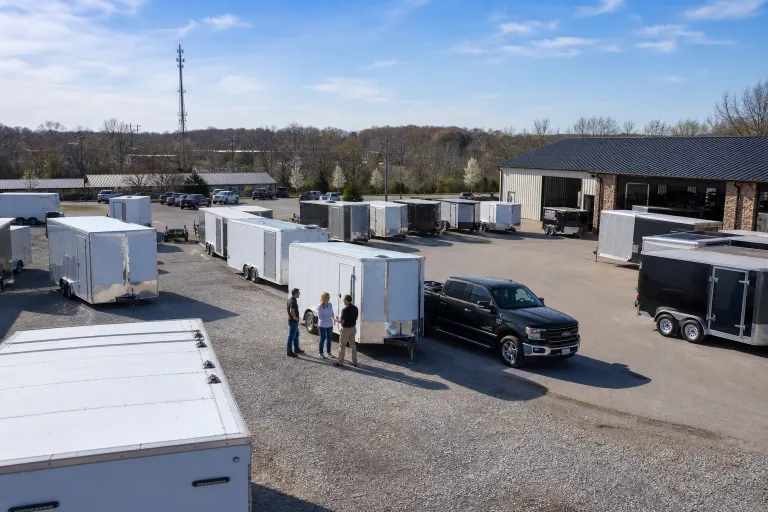
Rather than treating every enclosed trailer as interchangeable, Daves Trailer Sales helps customers compare available models by trailer type, dimensions, manufacturer, condition, features, and intended use. Its Glen Burnie location serves as a local resource for Baltimore buyers who want to review their options and ask questions before making a purchase.
A useful conversation starts with the cargo. Bring measurements of the longest, widest, and tallest items to be carried. Buyers should also estimate the loaded weight, identify the tow vehicle, and decide whether the trailer will be used every day, seasonally, or only for occasional projects. Those details make it easier to select a configuration that works in practice.
How Can Buyers Avoid Cargo and Towing Mistakes?
Correct trailer selection is only the first step in safer hauling. Cargo should be distributed as evenly as possible from side to side, with appropriate weight placement from front to rear. Never exceed the trailer’s capacity, tire ratings, axle ratings, hitch rating, or the vehicle manufacturer’s towing limits.
Loads also need to be secured for normal driving conditions and sudden stops. The National Highway Traffic Safety Administration’s cargo-security guidance notes that roughly 850 people are killed and nearly 19,000 are injured annually in crashes involving objects in the road. Straps, tie-downs, proper loading, and a final pre-trip inspection all matter. Daves Trailer Sales can help customers identify suitable trailer specifications, hitches, brakes, lighting, and replacement parts for their needs.
Why Is Ongoing Parts and Service Support Important?
An enclosed trailer is often a long-term tool for work or recreation, not a one-time purchase. Daves Trailer Sales supports customers with trailer parts and repair services, including hitch installation, brake repair, brake conversions, trailer checkups, enclosed trailer panel repair, and boat-related adjustments.
This support can reduce downtime for contractors, landscapers, tradespeople, small businesses, and recreational users. For example, a contractor may initially purchase an enclosed trailer for tools, then later need tires, bearings, lights, brakes, coupler components, tie-down hardware, or panel repairs. Having a local source for both the original trailer and future service needs can simplify ownership.
Can Daves Trailer Sales Help With Maryland Registration?
Maryland title and registration requirements can vary based on a trailer’s weight, use, and ownership history. The Maryland MVA trailer title and registration guide explains that some trailers may require both titling and registration, while others may require only titling. Requirements should be confirmed before the purchase is finalized.
Buyers may need proof of ownership, VIN or serial-number information, title documents, identification, and payment for applicable fees and taxes. Daves Trailer Sales offers on-site tag-and-title assistance for Maryland customers, making the purchase process more convenient. Special situations, private-party purchases, and out-of-state trailers may require additional confirmation with the MVA.
How Should Buyers Match a Trailer to Its Main Use?
-
Contractors: Prioritize interior height, payload, shelving potential, security, and ramp access for tools and materials.
-
Landscapers: Consider equipment length, protected flooring, ventilation, easy loading, and frequent towing demands.
-
Motorcycle owners: Review ramp design, wheel clearance, tie-down placement, interior width, and lighting.
-
Small businesses: Focus on secure storage, usable cargo space, branding opportunities, and dependable daily operation.
-
Household and event users: Balance weather protection, maneuverability, storage needs, interior organization, and budget.
What Makes Daves Trailer Sales a Practical Local Option?
Daves Trailer Sales has operated in Glen Burnie since 1980 and offers enclosed trailers, as well as utility, dump, boat, car hauler, motorcycle, landscape, kayak, and pontoon trailers. When a particular configuration is unavailable, the dealership may be able to help customers place a special order.
Its combination of trailer sales, financing options for qualified buyers, parts, repair service, hitch work, and tag-and-title support gives Baltimore-area customers a connected ownership resource. That can be especially valuable when a trailer needs maintenance after the sale or when a buyer needs help selecting equipment that matches a specific job.
Frequently Asked Questions
Does Daves Trailer Sales carry enclosed cargo trailers?
Yes. Enclosed trailers are among the trailer categories offered by Daves Trailer Sales. Buyers should confirm current inventory, features, pricing, and availability directly with the dealership.
Where is Daves Trailer Sales located?
Daves Trailer Sales is located at 432 Crain Highway N. in Glen Burnie, Maryland, making it a convenient local option for many Baltimore-area trailer buyers.
What should I ask before buying?
Ask what the trailer will carry most often, how much the loaded cargo weighs, whether the tow vehicle can safely handle the trailer, which door style is most useful, and what parts or services may be needed over time.
Choose a Trailer That Fits the Whole Job
Daves Trailer Sales helps Baltimore buyers approach an enclosed cargo trailer purchase with the full picture in mind: cargo dimensions, loaded weight, tow-vehicle capability, useful features, registration needs, and future maintenance. Starting with the right questions can lead to a trailer that protects equipment, supports safer hauling, and remains useful for years to come.
